Topi
Topi stand about 45 in (113 cm) to about 46 in (115 cm) tall at the shoulder and weigh from 108 kg (238 lb) to 130 kg (286 lb). Their coats are a rusty red colour with purple blotches on the upper limbs. The horns are lyre-shaped and are conspicuously ringed and can reach between 30-60 cm (12-24 in) centimetres in both sexes.
They live in savannah and floodplains where they favor medium-length grass. These animals can go without drinking if green grass is available, but drink every day or two when grass is dry.
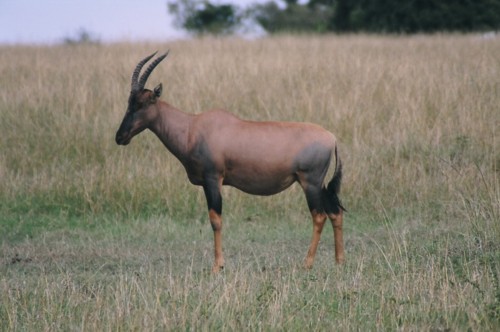 © Siggi Hosenfeld
They are build for speed with lean body's and will sometimes jump over each other to get away from a threat.
Being gregarious, they spend much of their life with other antelopes such as wildebeest, and with zebra and ostrich.
These animals are exceptionally gregarious and live in herds of 15 to 20, although in some places, it is possible to see herds of hundreds. They have a remarkable social organization that is linked to the geographic and seasonal distribution of food.
In some areas of the Serengeti and the Mara, topis have large territories within a home range, occupied throughout the year by a male and a small breeding herd of females. Both males and the females cooperate in defending the territory against strangers of either sex.
Males will engage in fights for territory and these are fought by lunging on to their knees while pushing each other to and fro with their horns.
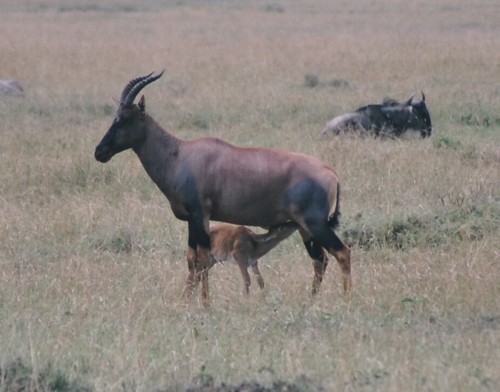 © Siggi Hosenfeld
The migrational pattern, adapted to large open plains where they are concentrated sometimes in thousands, allows a sup-population to move together en masse.
They are most active in the morning and evening, resting in shade through the hot hours. In early mornings, spirited tournaments are frequent in bachelor herds.
Good places to see them are in the Masai Mara National Reserve and the Serengeti National Park in Tanzania.
Return from the Topi page back to the Kenya Wildlife List

