Warthog
The shoulder height of the warthog is about 60-70 cm and the weight up to 100 kg. The Swahili word is ngiri.
This widespread and often conspicuously abundant resident of the African savanna is grey in color with a thin covering of hairs, wart-like bumps in its face, and large upward-curving tusks.
It’s often seen in family groups, with parents and piglets trotting briskly in a straight line with tails erect.
It is the most common wild pig in Kenya and can be seen regularly throughout Kenya up to altitudes of over 2000m.
If alarmed, they rush through the bush for cover, going backwards down their holes, which makes it notoriously hard for photographers to get a photo.
They do have the cutest run thought with their tails straight up in the air. Can't miss them!
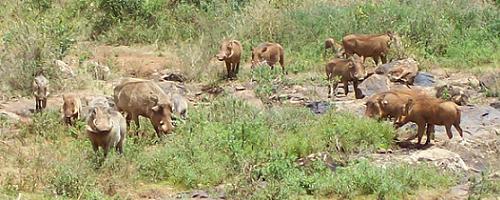 © Siggi Hosenfeld
Although warthogs dig quite well, their shelter is usually an old aardvark burrow. Whether they choose to live in areas uninhabited by aardvarks is an open question.
Boars join the groups only to mate, and are distinguishable from sows by their prominent face warts, which are thought to be defensive pads protecting their heads during often violent fights.
Although a favorite prey animal for large cats – and humans – the animals survival doesn’t appear to be threatened, as of the early years of 2000, although its rooting and wallowing behavior brings it in to conflict with farmers.
Cheetahs do think twice before tackling an adult, as mothers defending their offspring often chase them and they can be fierce.
Although the burrows keep them safe at night, emerging in the morning can be a risky business, since lions are clever enough to sniff out occupied burrows and patient enough to wait in ambush at breakfast time.
Best places to see them are in the Nairobi and Amboseli National Parks and in the Masai Mara National Reserve.

